Crypto APR vs APY: Compare the Return You Can Actually Earn
A higher advertised yield does not automatically produce a larger account balance. APR and APY can describe different compounding assumptions, while a short holding period, fees and changing rates can alter the result. Compare the cash flows before ranking two crypto products.
Put both quotations on the same basis
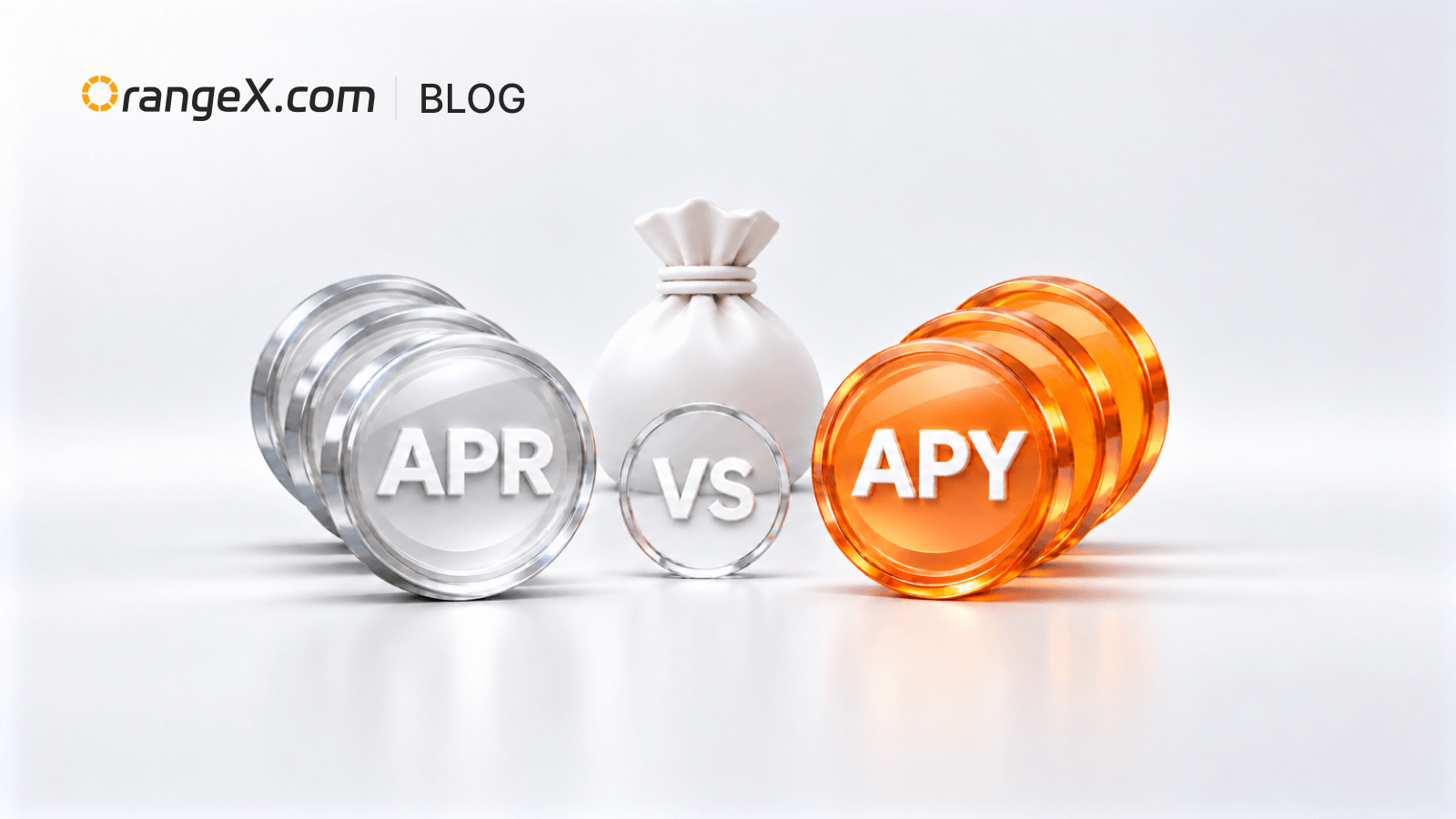
APR is an annualized rate that does not by itself include the effect of reinvesting rewards. APY expresses an annual result with a specified compounding assumption. Providers can calculate and label reward rates differently, so read the product methodology rather than relying on the acronym alone.
For a constant nominal annual rate r compounded n times per year, the mathematical conversion is APY = (1 + r/n)^n - 1. It assumes rewards become eligible principal each period and the same rate continues. It does not establish that a crypto product will pay that rate, remain available or protect principal.
Record the reward asset, eligible balance, rate tiers, start time, payment schedule and redemption conditions. A rate applying to only the first part of a balance cannot be applied to the entire deposit.
A hypothetical 90-day comparison
Assume a 1,000-token deposit, a constant token price, no fees and a 365-day convention. Product A quotes 12% APR with rewards paid separately and no reinvestment. Over 90 days its reward is 1,000 × 0.12 × 90/365, approximately 29.59 tokens.
Product B quotes 12% APY with its compounding assumptions achieved. An equivalent smooth accrual model gives 1,000 × ((1.12)^(90/365) - 1), approximately 28.34 tokens. Actual product payment periods and rounding can change the amount.
The matching headline number does not make these quotations equivalent. If A instead compounded its 12% nominal annual rate monthly for a full year, its illustrative APY would be approximately 12.68%. These are arithmetic scenarios, not available offers or forecasts.
When reinvestment does not happen
Rewards may stay in a separate wallet, require a manual claim, fall below a minimum subscription or arrive after the next accrual cutoff. A lockup can prevent reinvestment. Network costs can make frequent manual compounding uneconomic for small balances.
Compare final withdrawable principal plus rewards after charges. A five-token claim-and-reinvestment cost would consume a significant part of the hypothetical 90-day reward. Do not treat an annualized rate as a guaranteed payment for a shorter term.
Separate token returns from purchasing power
Earning more units does not ensure a positive fiat return. If token units increase by 3% while the token price falls 10%, the combined value changes by 1.03 × 0.90 - 1 = -7.3%, before costs. A stablecoin can also lose its peg; a displayed yield does not remove issuer, custody or redemption risk.
Before using an OrangeX product, check its current product page and applicable terms for the supported asset, rate method, limits and redemption rules. This article does not assert a current OrangeX rate or automatic compounding feature.
A practical comparison sheet
For each product, write down the same deposit amount and holding dates. Estimate rewards under the documented accrual convention, then subtract unavoidable fees. Run a second scenario with a lower variable rate and another with delayed redemption. Compare the amount available when you need it, alongside the risk of obtaining that amount.
Sources
- CFPB: how compound interest works
- Compound: interest rates and utilization
- OrangeX markets and product navigation
Research checked November 5, 2026 (Asia/Shanghai). All numerical examples are hypothetical.