What Are Stock Perpetual Futures? Pricing, Funding and Risk
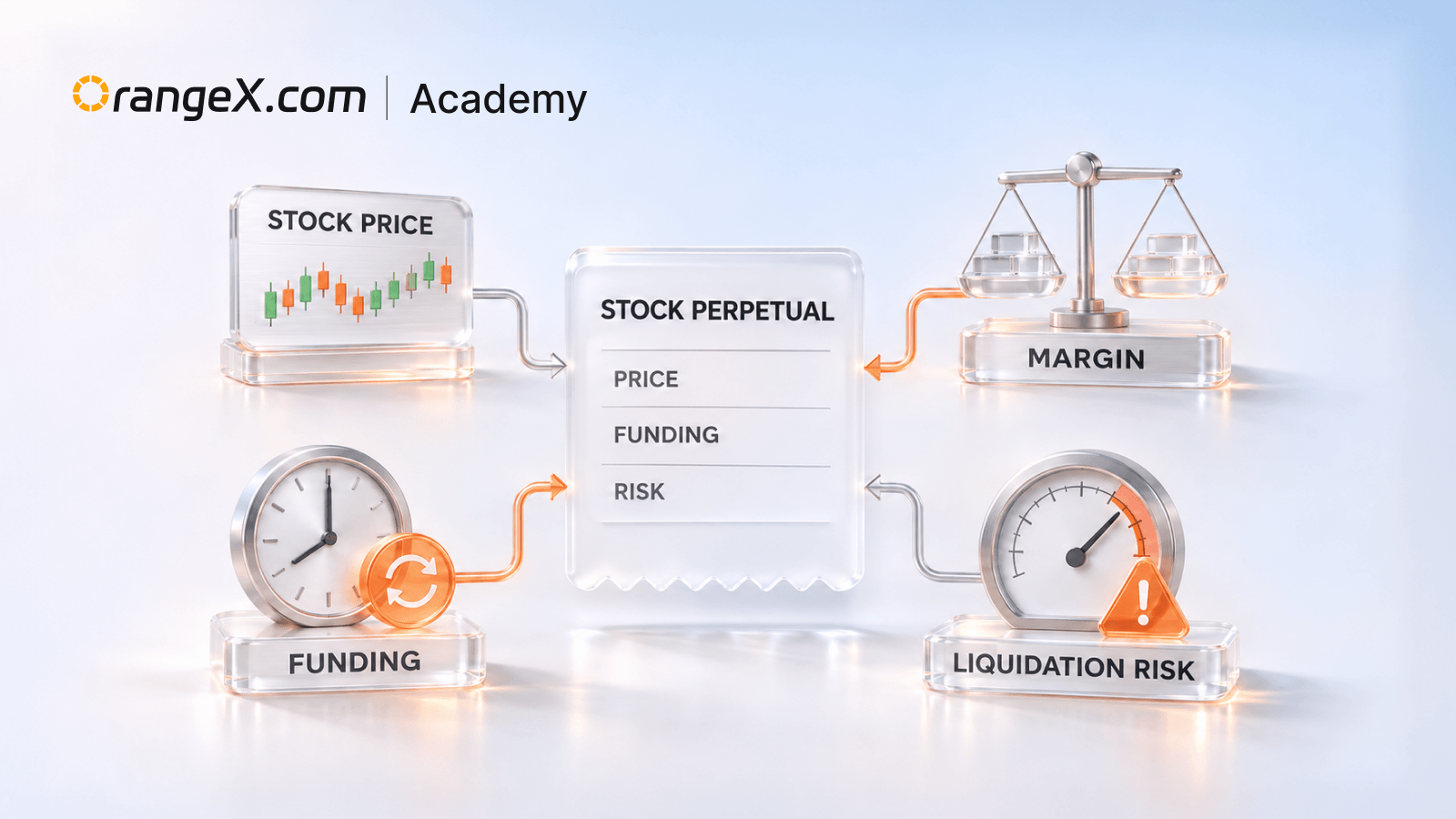
A stock perpetual future is a derivative that gives you exposure to the price of a stock without buying shares. It has no scheduled expiry. While a position is open, its value can change with the contract price, periodic funding can add a cost or credit, and a leveraged position can be liquidated if its margin falls too low.
Suppose you see a stock ticker on a crypto trading screen after the regular share session has ended. Before you interpret the move, check which instrument is trading. A change in the perpetual contract tells you where that contract traded. The underlying stock has its own trading sessions and price history.
What do you own when you buy a stock perpetual?
When you buy a share, you acquire an ownership interest in a company. Depending on the share class, that can include voting rights and eligibility for dividends. A long stock perpetual gives you contractual exposure to a price move. It gives you no shares, shareholder voting rights or entitlement to cash dividends as a shareholder. Check the contract terms for how the platform treats corporate actions such as splits and dividends.
OrangeX.com’s November 2026 stock perpetual listing announcement scheduled TTWOUSDT trading for November 4 at 13:00 UTC. The TTWO/USDT perpetual contract references Take-Two Interactive Software stock and uses USDT. On November 9, the contract page displayed a last price of 218.16 and a mark price of 218.15 during our check. This was a point-in-time snapshot of the contract screen. For a current reading, open the pair page and check its displayed prices.
Why can a stock perpetual move when the stock market is closed?
A share and a perpetual contract trade on separate order books. If the perpetual remains open outside the underlying stock’s regular session, participants can change their bids and asks in response to news. A thin book can make a small trade move the last price, and the underlying share can reprice when its market reopens. Check the session and timestamp before comparing quotes.
On the contract page, three prices answer different questions.
- Last price shows where the most recent contract trade executed. Check the current bid, ask and depth for a better view of what your order might receive.
- Index price provides a reference under the platform’s pricing rules. Check what the reference represents before comparing it with a quote from a different session.
- Mark price is a calculated reference. OrangeX.com uses it for liquidation and, by default, for unrealized P&L. See the OrangeX.com perpetual trading guide for where to find those figures and the estimated liquidation price.
How do funding and leverage change the result?
Suppose you open a hypothetical long position for 5 units at 200 USDT per unit. The position’s notional value is 1,000 USDT. If you later exit all 5 units at 204 USDT, the gross price gain is 20 USDT. An exit at 196 USDT produces a gross price loss of 20 USDT. Both examples exclude trading fees and funding.
If the position value used for a funding event is 1,000 USDT and the funding rate is +0.01%, a long that pays at that event would incur 0.10 USDT in funding. This example uses an assumed rate. For the actual contract, check TTWOUSDT funding rates and the countdown on the pair page. The rate and the direction of the payment can change while you hold the position.
At 5× leverage, 1,000 USDT of exposure implies roughly 200 USDT of initial margin before any platform-specific requirements. A 20 USDT price loss is 2% of the position value and about 10% of that illustrative initial margin. Actual liquidation depends on the mark price, maintenance margin, margin mode and available collateral. A rapid price move can lead to liquidation before a position has time to recover.
What to check before opening a position
- Instrument and session. Confirm you are looking at the stock perpetual and check when its reference market last traded.
- Likely execution. Read both sides of the order book. A limit order sets a price boundary, but it may fill partly or remain open.
- Holding cost. Check trading fees, the next funding time and which side would pay at the displayed rate.
- Risk in USDT. Review the full position value and estimated liquidation price. Consider what a wider spread or a price gap would do to the amount you could lose.
Frequently asked questions
Does a stock perpetual expire?
It has no scheduled expiry. Check the contract’s terms for how the platform handles interruptions, adjustments or delisting.
Can I compare the contract price directly with the stock’s closing price?
You can use the close as a reference if you label its timestamp and session. For a more meaningful comparison, check the contract’s index price, quote currency and the age of both prices. A difference alone gives you little information about where either instrument will trade next.
Does owning the contract make me a shareholder?
No. The position is a derivative. If you are comparing it with holding the underlying share, include ownership rights, funding, fees, trading sessions and liquidation risk in the comparison.