What Is a Funding Rate in Perpetual Futures?

A funding rate is used by many perpetual-futures markets to help keep contract prices near a reference spot price. At scheduled times, a funding payment can move between long and short position holders. It is separate from the trading fee and can either increase or reduce a position's result.
Why perpetual contracts need a funding mechanism
A traditional futures contract has an expiry date that creates a convergence point with its settlement reference. A perpetual contract has no scheduled expiry. Funding creates an economic incentive that can discourage the contract from trading persistently above or below the reference market.
When the rate is positive, long holders generally pay short holders. When it is negative, short holders generally pay long holders. This direction is a mechanism, not a forecast. A positive rate does not prove that price will rise, and receiving funding does not remove market or liquidation risk.
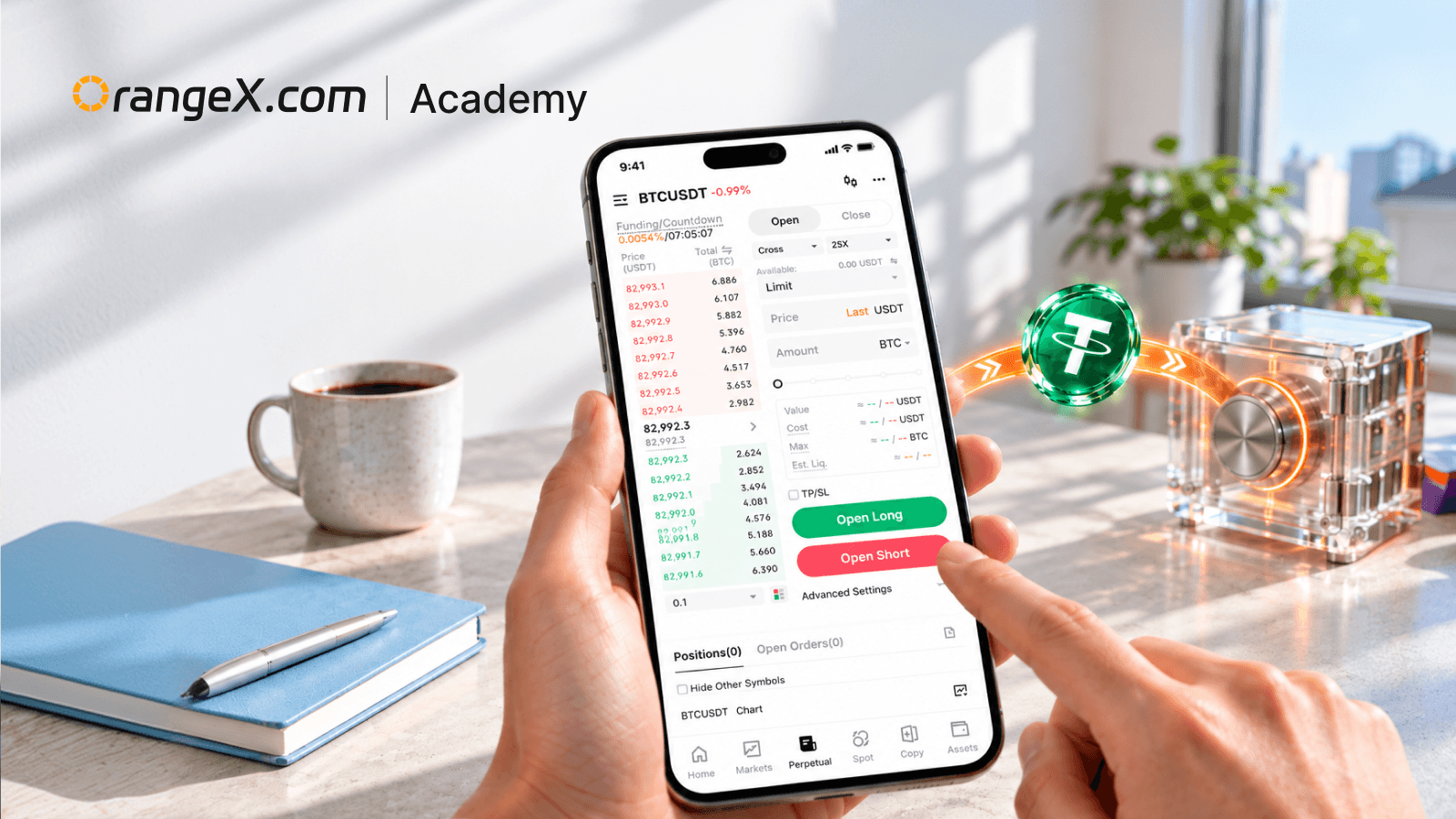
OrangeX.com's funding-rate guide describes the long-short transfer and displays the rate and settlement countdown in the perpetual interface. Current intervals and caps can differ by contract and can change, so the live contract page is authoritative.
Calculate the payment from notional value
A simplified formula is:
Funding payment = position notional value × funding rate.
Suppose a trader holds a long position with 20,000 USDT of notional value at a hypothetical positive funding rate of 0.01%. The payment would be 2 USDT:
20,000 × 0.0001 = 2 USDT.
Under the positive-rate convention, the long side pays and the short side receives, subject to the platform's rules. If the rate were -0.01%, the direction would reverse. This example excludes other costs and does not represent a current OrangeX.com rate.
Notional value is not the same as posted margin. A 20,000 USDT position supported by 2,000 USDT of margin still uses the position notional in the simplified funding calculation. Leverage can therefore make the payment large relative to margin.
Timing determines whether a payment applies
Funding normally applies only if the position is open at the relevant settlement time under the contract rules. Opening just before or closing just after a timestamp can change whether a payment is assessed, but attempting to trade around the event introduces spread, fee, execution and price risks.
Do not assume every contract uses the same interval. OrangeX.com has published contract-specific funding updates, demonstrating that settlement frequency and caps can be adjusted. Check the countdown and current specification for the exact market.
A displayed estimated rate may update before settlement. Treat it as changing information rather than a fixed coupon promised in advance.
Funding and profit or loss are separate
Imagine a long position earns 30 USDT from price movement but pays 4 USDT in funding and 3 USDT in trading fees. Its simplified net result is 23 USDT before any other adjustments. A position can be profitable before costs and less profitable afterward.
The reverse is also possible: receiving funding can partially offset a trading loss, but it does not guarantee a positive result. Mark-price movement can produce losses much larger than one funding payment and can trigger liquidation if margin requirements are breached.
Funding history, trading-fee records and realized profit-and-loss records should therefore be reviewed separately.
What to check before holding through settlement
Confirm the contract, long or short direction, notional value, current estimated funding rate, settlement countdown and margin mode. Estimate both payment directions because the rate can change sign. Then compare the possible funding amount with available margin rather than only with the asset quantity.
Also check whether other positions share collateral under cross margin. A funding debit in one position can reduce account equity supporting another. Notifications are not a substitute for monitoring the account.
Common questions
Is funding the same as interest on a loan?
No. It is a contract mechanism linked to the relationship between the perpetual and reference market, although it is a recurring position cost or receipt.
Does OrangeX.com keep the funding payment?
The cited OrangeX.com guide states that funding transfers are made between traders and the platform does not take a fee from that transfer. Check the current rules for the selected contract.
Does a positive rate mean I should open a short?
No. The rate alone does not predict price direction or account for liquidation, execution and other costs.
Review the live contract specification on OrangeX.com and use Academy for related margin and liquidation lessons.