Chainlink vs Pyth: Compare Data Delivery Before Comparing Tokens
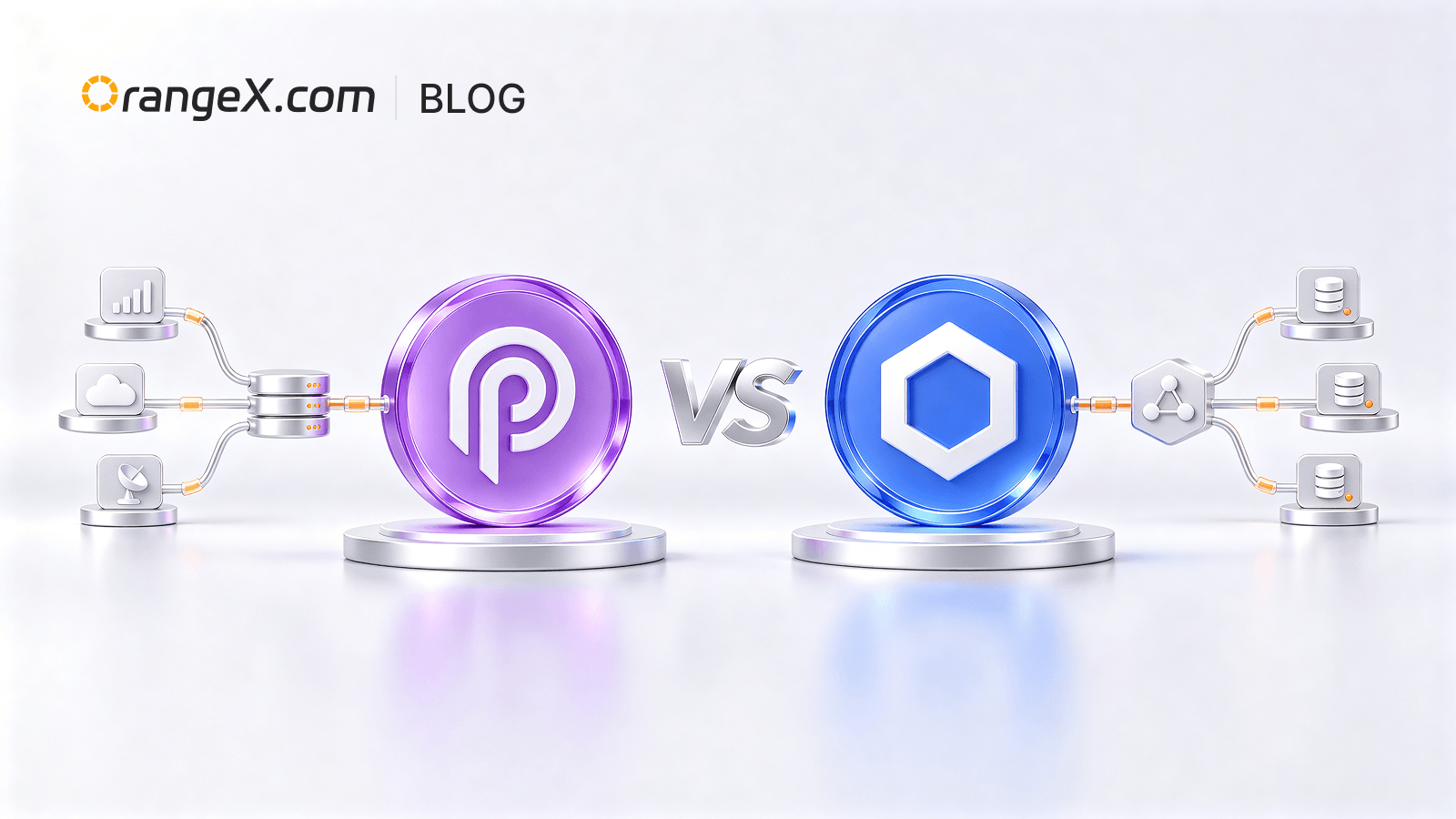
Chainlink and Pyth both deliver external data to blockchain applications, but the phrase oracle network hides several design decisions. Data origin, aggregation, update conditions, delivery timing, verification and application safeguards can differ. Compare the service path first, then ask whether network usage creates demand for LINK or PYTH.
This article is a neutral comparison framework. It does not rank either project or predict the price of either token.
Map the full path from source to contract
An oracle value does not appear directly from the physical world. A complete map includes the original data publishers or exchanges, any off-chain aggregation, the network of operators, the signed report, the on-chain verification contract and the application that consumes the result.
Ask who can add or remove a source, how outliers are handled, what happens during a venue outage, and where the final value is stored. The number of feeds or supported chains is useful context, but it does not answer whether a specific feed fits a specific application's risk.
Use the exact feed and network in the comparison. A crypto/USD price feed, a foreign-exchange rate, a reserve attestation and a low-latency derivatives stream can have different providers, update policies and trust assumptions under the same brand.
Separate push and pull delivery
In a push-style feed, a network publishes updated data on-chain when configured conditions are met. A consuming contract reads the latest stored answer. This can make the value broadly available, but the application must still check freshness, round status and network-specific conditions.
In a pull-style design, signed updates are made available off-chain and a user or application submits a recent update when calling the contract. The contract verifies the message before using it. This can support more frequent data and avoid paying to publish every update on every chain, but the application must handle update fees, submission logic and acceptable age.
Do not reduce the comparison to old versus new. Chainlink offers multiple services with different delivery models, and Pyth integrations can use different update paths. Verify the current documentation for the product actually being integrated.
Compare update rules with the application's tolerance
Price feeds often use time-based and deviation-based triggers. A heartbeat can cause an update after a maximum interval, while a deviation threshold can cause an earlier update after a sufficiently large move. Pull integrations can request or submit a newer signed update for a transaction.
The right setting depends on the application. A lending protocol needs a price suitable for collateral and liquidation logic. A derivatives venue may need lower latency and stronger protections against stale or manipulated data. A display-only portfolio screen has a different failure cost.
Record the published timestamp, confidence information when available, maximum acceptable age, fallback behavior and circuit breaker. An application that reads a value without checking freshness can fail even when the oracle network operated as designed.
Examine source and aggregation risk
More sources do not automatically mean better data if the sources depend on the same underlying venue or methodology. Compare source diversity, liquidity filters, weighting, outlier rules and operator independence. Determine whether the feed represents a spot composite, a derivative, an index or another reference.
Market disruption is the important test. Ask what happens when one exchange disconnects, a stablecoin deviates, trading halts, or price dispersion expands. Review incident reports and contract upgrade controls rather than relying only on normal-period uptime claims.
For cross-chain deployments, also inspect the chain's finality, sequencer availability and bridge or messaging dependencies. An accurate off-chain price can still reach an application late or be used incorrectly.
Separate protocol utility from token value
LINK and PYTH have roles described by their respective ecosystems, including governance, staking or service incentives under current designs. Those roles can change. A network handling more updates does not automatically transfer a proportional amount of economic value to token holders.
Create separate rows for service revenue or fees, payments to data providers and operators, staking requirements, token emissions, governance powers and treasury decisions. Identify which fees are paid in the native token, which can be paid in another asset, and who receives them.
Supply also matters. Compare circulating supply, unlock schedules, rewards and governance changes with dated official material. Avoid treating token market capitalization as the value of the oracle service business.
Build an integration scorecard
Use six rows: feed coverage, source construction, update and latency model, verification and application checks, incident and governance history, and total integration cost. Weight the rows for the intended application rather than declaring a universal winner.
Test a failure scenario. If no fresh update arrives for ten minutes, does the application pause, use a bounded last value, switch feeds or continue liquidating positions? If two sources diverge sharply, which rule decides? The answers matter more than a generic label such as decentralized oracle.
If OrangeX lists an instrument involving LINK or PYTH, verify the exact spot or perpetual product, quote asset and current market conditions before trading. Technical adoption does not guarantee token price performance.
Sources
Research checked November 13, 2026 (Asia/Shanghai).